
Back for a second investment, we have doubled down on one of our most promising companies from CVCF 1
With its first deployment, CVCF2 is proud to lead a $2m investment round in Liquium, the Wellington-based deep-tech company tackling one of the world’s hardest-to-decarbonise industries: ammonia.
We now hold about 17 percent across both CVCF vintages, signalling high-conviction follow-on support as it moves from laboratory performance into industrial-scale validation.
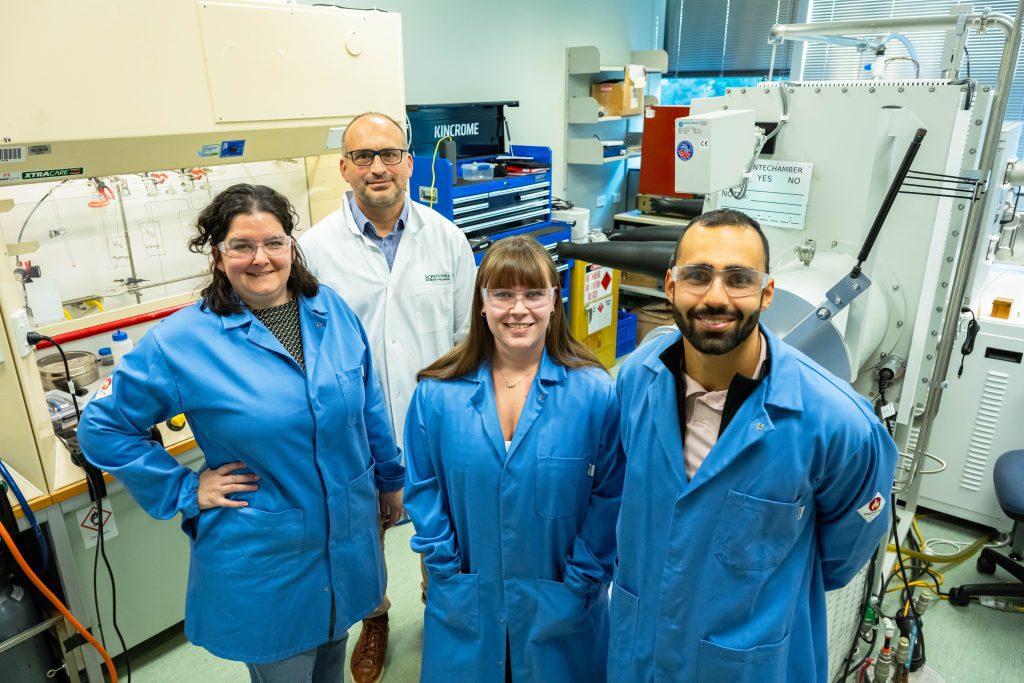
Some of the Liquium team in the Wellington lab
Ammonia is one of the largest, least-discussed climate problems. It’s hiding in plain sight.
Globally, more than 180 million tonnes is produced each year. Ammonia underpins global food systems through fertiliser, and is emerging as a potential low-carbon fuel. Yet its production accounts for roughly two percent of global carbon dioxide emissions, largely due to the fossil fuel sources to isolate the hydrogen and required high energy needs to power the century-old Haber-Bosch process.
Liquium stands out because it tackles the existing system rather than hoping to replace it. The science is strong, the pathway to adoption is short, and the potential emissions savings are enormous.
Rather than attempting to replace existing ammonia plants, the company has developed a family of proprietary catalysts to greatly improve the efficiency of the Haber-Bosch process itself. For producers, even small percentage efficiency gains can translate into hundreds of millions of dollars in energy savings over the life of a plant.
Early validation work indicates Liquium’s catalyst has demonstrated a potential improvement of more than 2x in ammonia productivity compared with incumbent commercial catalysts under relevant operating conditions.
Why this matters
Scale: Ammonia production accounts for around two percent of global CO₂ emissions. Small efficiency gains compound at massive scale.
Adoption: Liquium’s catalyst is designed to retrofit into existing plants, lowering barriers to industrial uptake.
Economics: Improved catalyst performance reduces energy input, cutting both emissions and production costs.
Geopolitics: Lower-cost, lower-carbon ammonia supports food security and emerging clean fuel markets worldwide.
Capital use
The new funding will be used to expand Liquium’s technical team, scale catalyst manufacturing capacity, and support larger and longer-duration validation campaigns with international partners. It will also support preparation for Liquium’s next investment campaign planned to commence later in 2026.
Unlike many climate startups focused on software or downstream optimisation, Liquium operates squarely in the realm of hard science. Its intellectual property is built around catalyst chemistry, materials engineering and process integration, creating long-cycle defensibility in an industry where incremental improvements can deliver outsized economic and emissions benefits.
As geopolitical pressures, fertiliser price volatility and energy security concerns converge, interest in lower-cost, lower-emissions ammonia production is growing rapidly. Liquium’s bet is that better chemistry, rather than wholesale reinvention, may offer one of the fastest routes to technology adoption to decarbonising a critical global industry.
Growing support
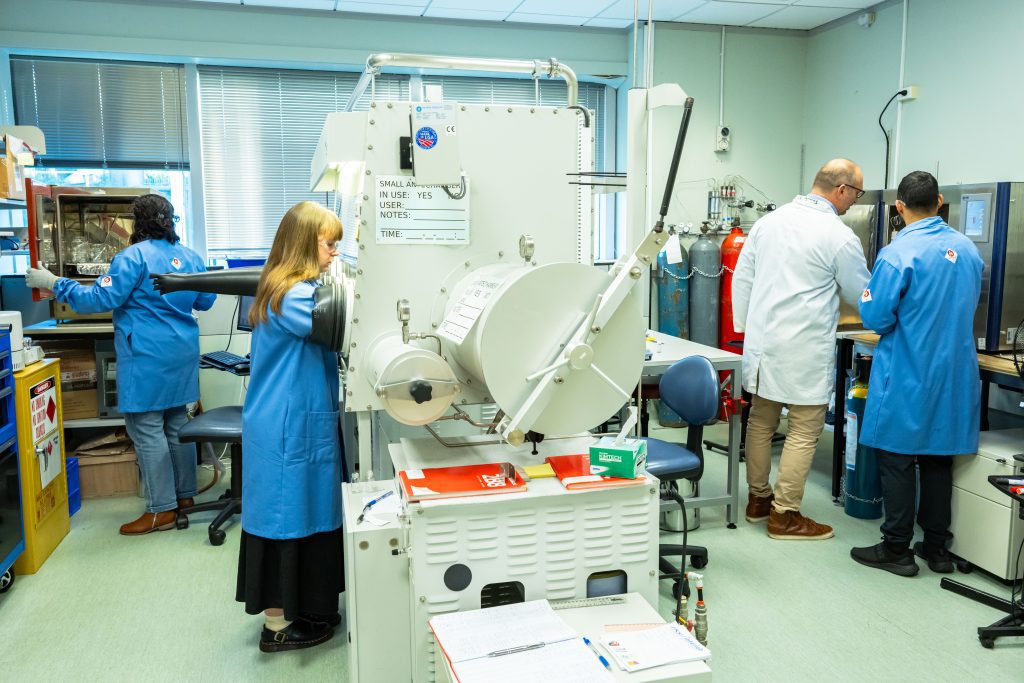
Liquium’s unique catalysts and huge potential performance gains have attracted the attention of key players in the ammonia market, from engineering companies, fertiliser producers, shipping lines, mining companies and others.
Liquium is currently working with a number of large-scale industrial partners across Europe, Australia and North America, under structured agreements to validate the catalyst performance in environments that reflect real-world production and solve the key barriers to market adoption. Looking ahead, Liquium is investigating additional and larger scale trials with international market participants over the coming year.
In our media release, chief executive Dr Paul Geraghty (pictured above) said the capital raise reflects growing confidence that the company’s approach can translate scientific performance into industrial impact.
“Ammonia production is a conservative, capital-intensive industry, and for good reason,” Geraghty said. “Our focus has always been on working with that industry. Our results suggest we could deliver very large efficiency gains with the aim to be a drop in solution and not requiring producers to rebuild their plants from scratch. That combination is what makes adoption of our technology so appealing and impactful at global scale. Importantly, considering the enormous clean energy market and ammonia uptake lowering green premiums and improving productivity is likely one of the fastest and most effective ways to help reduce global energy emissions.”
See Press Release Liquium CVCF2 for more. Read coverage of the investment by BusinessDesk
Discover how to invest in Climate Fund 2